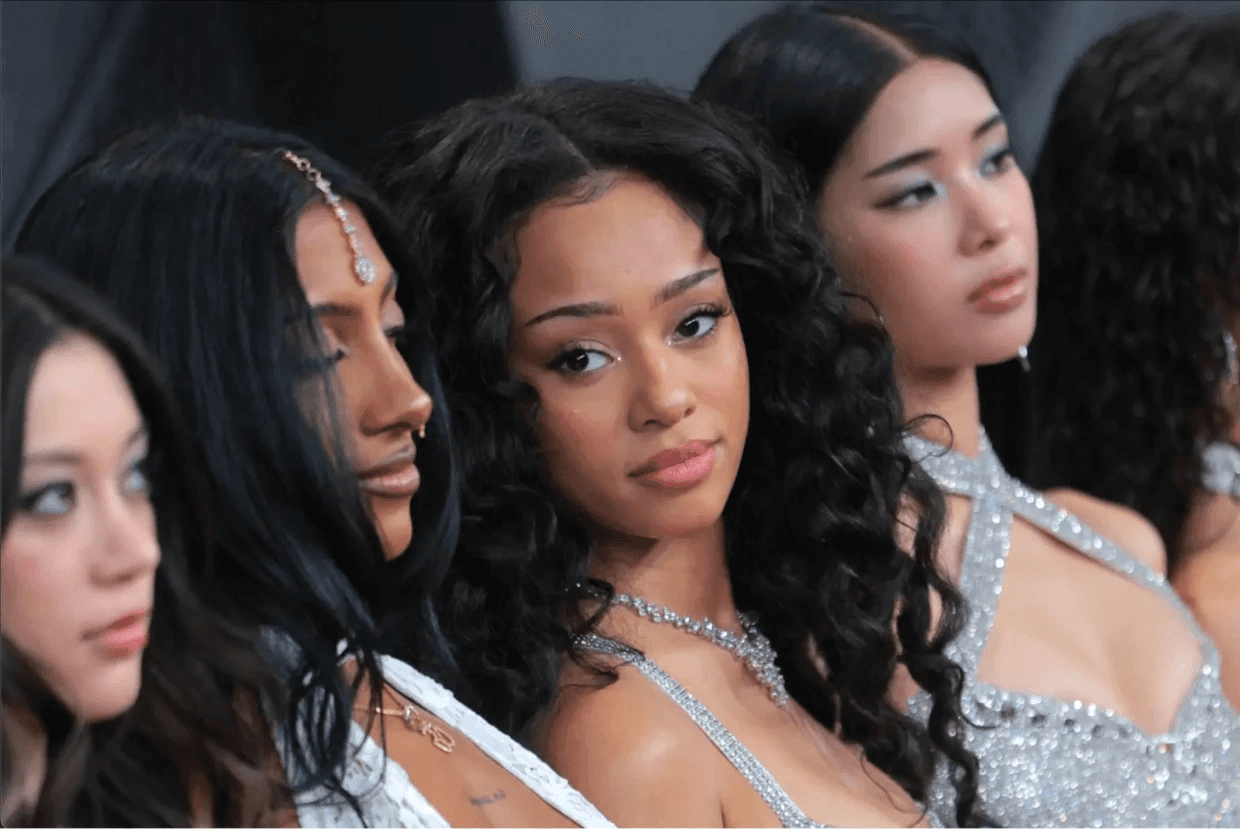
Etienne LAURENT / AFP via Getty Images
Etienne LAURENT / AFP via Getty Images
Twice as Hard, Still Twice the Disrespect: KATSEYE’s Manon’s Hiatus
Twice as Hard, Still Twice the Disrespect: KATSEYE’s Manon’s Hiatus
On Feb. 20, 2026, HYBE and Geffen Records announced on the social media platforms X and Weverse that Manon Bannerman, a member of the girl group KATSEYE, was taking a temporary hiatus, writing: “after open and thoughtful conversations together, we are sharing that Manon will be taking a temporary hiatus from group activities to focus on her health and wellbeing.”
Created by entertainment company HYBE and Geffen Records, KATSEYE, a global girl group comprising six women, officially debuted in the summer of 2024 with the intention of bridging the gap between the K-pop industry and the American music audience.
Following their debut and the Netflix series “Pop Star Academy: KATSEYE,” the girl group has continued its rise to fame, appealing to many teenage and young girls. One of their most prominent members is Manon, a mixed-race Black woman who serves as the group’s visual, the face of the group.
Unlike the other members of KATSEYE, Manon already had a social media presence prior to joining the girl group. As a result, during the voting section of KATSEYE’s formation process, Manon received ample support, heavily contributing to her placement in the six-membered group.
Second to Lara Rajj, Manon has one of the largest Instagram fan bases, with 5.7 million followers.
“She’s been on my Pinterest mood board for years,” sophomore English major Zuri Riggins said. “She’s just that girl.”
Not only does Manon attract a large number of fans to KATSEYE, but she also helps them maintain the “global” girl group status as the only Black member. Moreover, being the sole Black woman, she is beloved by Black KATSEYE fans, or “eyekons.”
“It was very uplifting to see someone who looks like me on a big stage,” sophomore Biology major Natania Bertin said.
Due to these factors, the sudden announcement of her hiatus was widely unexpected and quickly sparked mass discourse among fans.
In the production company’s statement, they cited her temporary absence as health-related. However, shortly after, Manon allegedly shared on Weverse that she is healthy, writing, “I’m healthy, I’m okay, and I’m taking care of myself [...] Sometimes things unfold in ways we don’t fully control, but I’m trusting the bigger picture.”
The emphasis on her positive health status and ambiguous ending about the lack of control over her circumstances led fans to believe she was forcefully put on hiatus for reasons other than health.
Fans all across the internet shared their support for Manon, with hashtags “#JusticeForManon” and “#WeWantManon.” They were soon joined by Black pop and R&B singers, such as SZA and Chloe Bailey, writing supportive comments. Notably, Normani, the only Black member of Fifth Harmony; Leigh-Anne Pinnock, the sole Black woman in Little Mix; and Melody Thornton, the only Black girl in the Pussycat Dolls, all publicly supported Manon as well.
“I think there’s inadvertently or subconsciously some treatment towards Black women that definitely needs to be accounted for,” Riggins said.
Some might believe questioning the role of race is trivial. However, it would be remiss to ignore its impact, especially given Manon’s position as the only Black woman in the group. In reality, the poor treatment that she and other Black girl group members experience has a direct correlation with harmful racial stereotypes about Black people. Manon’s work ethic has constantly been questioned with a repeated emphasis on her supposed laziness.
Sophomore Political Science major Skye Davis reflects on her experience watching “Pop Star Academy: KATSEYE."
“The other girls were framed as hard workers, but Manon’s arc was to always have her position reevaluated and questioned," she said.
In addition to her character arc on the girl group’s Netflix series, late last year, the company reinforced this lazy narrative in KATSEYE’s magazine, Mod and Mad 2026 Season’s Greetings. One question read, “What does Manon think is her best feature?” and the options were: “her sense of humor, her selfishness, her laziness, or her quiet nature.”
The inclusion of laziness highlights the production company's intentional efforts to poorly characterize Manon. Moreover, it calls into question their intent to negatively label the only Black woman within the group, while no other member receives similar criticism.
“Being called lazy, especially as a Black girl, is not fair. Now I feel like I always need to put in extra work to prove something, even though I really don’t,” Manon told The Cut.
Since the beginnings of race’s establishment as a concept, laziness has been associated with Blackness. Historically, this association appears in discourse surrounding employment rates, welfare and fatphobia, all equating black people’s outcomes to laziness.
As a result, Black people overwork themselves to disprove this assumption, and in turn causes those who do not be looked be condemned, as reflected in Manon’s experience with the group.
This statement echoes a similar message Leigh-Ann Pinnock shared years ago while retelling a story in which she was told, “You’re the Black girl. You’re going to have to work ten times harder.”
Manon is a hard worker, and her temporary absence in KATSEYE has not gone unnoticed. The immense support she has received shows her impact and the value she brings to KATSEYE, like many Black members of other girl groups.
On Feb. 20, 2026, HYBE and Geffen Records announced on the social media platforms X and Weverse that Manon Bannerman, a member of the girl group KATSEYE, was taking a temporary hiatus, writing: “after open and thoughtful conversations together, we are sharing that Manon will be taking a temporary hiatus from group activities to focus on her health and wellbeing.”
Created by entertainment company HYBE and Geffen Records, KATSEYE, a global girl group comprising six women, officially debuted in the summer of 2024 with the intention of bridging the gap between the K-pop industry and the American music audience.
Following their debut and the Netflix series “Pop Star Academy: KATSEYE,” the girl group has continued its rise to fame, appealing to many teenage and young girls. One of their most prominent members is Manon, a mixed-race Black woman who serves as the group’s visual, the face of the group.
Unlike the other members of KATSEYE, Manon already had a social media presence prior to joining the girl group. As a result, during the voting section of KATSEYE’s formation process, Manon received ample support, heavily contributing to her placement in the six-membered group.
Second to Lara Rajj, Manon has one of the largest Instagram fan bases, with 5.7 million followers.
“She’s been on my Pinterest mood board for years,” sophomore English major Zuri Riggins said. “She’s just that girl.”
Not only does Manon attract a large number of fans to KATSEYE, but she also helps them maintain the “global” girl group status as the only Black member. Moreover, being the sole Black woman, she is beloved by Black KATSEYE fans, or “eyekons.”
“It was very uplifting to see someone who looks like me on a big stage,” sophomore Biology major Natania Bertin said.
Due to these factors, the sudden announcement of her hiatus was widely unexpected and quickly sparked mass discourse among fans.
In the production company’s statement, they cited her temporary absence as health-related. However, shortly after, Manon allegedly shared on Weverse that she is healthy, writing, “I’m healthy, I’m okay, and I’m taking care of myself [...] Sometimes things unfold in ways we don’t fully control, but I’m trusting the bigger picture.”
The emphasis on her positive health status and ambiguous ending about the lack of control over her circumstances led fans to believe she was forcefully put on hiatus for reasons other than health.
Fans all across the internet shared their support for Manon, with hashtags “#JusticeForManon” and “#WeWantManon.” They were soon joined by Black pop and R&B singers, such as SZA and Chloe Bailey, writing supportive comments. Notably, Normani, the only Black member of Fifth Harmony; Leigh-Anne Pinnock, the sole Black woman in Little Mix; and Melody Thornton, the only Black girl in the Pussycat Dolls, all publicly supported Manon as well.
“I think there’s inadvertently or subconsciously some treatment towards Black women that definitely needs to be accounted for,” Riggins said.
Some might believe questioning the role of race is trivial. However, it would be remiss to ignore its impact, especially given Manon’s position as the only Black woman in the group. In reality, the poor treatment that she and other Black girl group members experience has a direct correlation with harmful racial stereotypes about Black people. Manon’s work ethic has constantly been questioned with a repeated emphasis on her supposed laziness.
Sophomore Political Science major Skye Davis reflects on her experience watching “Pop Star Academy: KATSEYE."
“The other girls were framed as hard workers, but Manon’s arc was to always have her position reevaluated and questioned," she said.
In addition to her character arc on the girl group’s Netflix series, late last year, the company reinforced this lazy narrative in KATSEYE’s magazine, Mod and Mad 2026 Season’s Greetings. One question read, “What does Manon think is her best feature?” and the options were: “her sense of humor, her selfishness, her laziness, or her quiet nature.”
The inclusion of laziness highlights the production company's intentional efforts to poorly characterize Manon. Moreover, it calls into question their intent to negatively label the only Black woman within the group, while no other member receives similar criticism.
“Being called lazy, especially as a Black girl, is not fair. Now I feel like I always need to put in extra work to prove something, even though I really don’t,” Manon told The Cut.
Since the beginnings of race’s establishment as a concept, laziness has been associated with Blackness. Historically, this association appears in discourse surrounding employment rates, welfare and fatphobia, all equating black people’s outcomes to laziness.
As a result, Black people overwork themselves to disprove this assumption, and in turn causes those who do not be looked be condemned, as reflected in Manon’s experience with the group.
This statement echoes a similar message Leigh-Ann Pinnock shared years ago while retelling a story in which she was told, “You’re the Black girl. You’re going to have to work ten times harder.”
Manon is a hard worker, and her temporary absence in KATSEYE has not gone unnoticed. The immense support she has received shows her impact and the value she brings to KATSEYE, like many Black members of other girl groups.