Morgan Richardson
Morgan Richardson
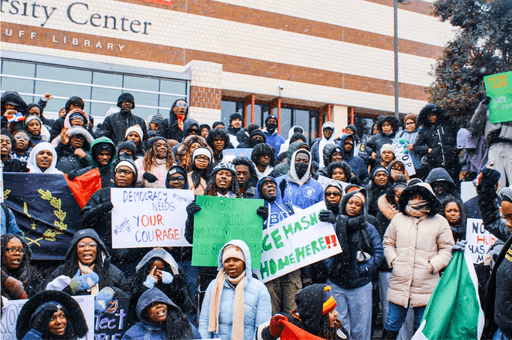
On Saturday, students from across the Atlanta University Consortium (AUC) gathered at the Robert W. Woodruff Library and marched to the Georgia State Capitol to protest injustice. The demonstration opened with a rally charging students to advocate and make daily change. The demonstration was preceded by a poster-making event, also hosted at the Robert W. Woodruff Library on Thursday.
The protest was a collaboration between the Clark Atlanta Chapter of The Accountability Initiative (TAI), an organization for young advocates that aids communities through advocacy, mentorship and service, and Legacies of the AUC, a student organization geared towards reminding AUC students of legacies they believe should be maintained.
The protest was promoted primarily through social media, with flyers posted on the Instagram accounts @taiclarkatl and @legaciesofthemovement.auc. The caption gives the protest’s purpose: “We are showing our voices openly in opposition to the current government administration, as well as the abuse of people of color, those who are impoverished, and we are taking a stand against ICE.”
Jacobi Johnson, a freshman political science major at Clark Atlanta and Vice President of the TAI, spoke about the motivation behind the event.
“We [students] are deep, and we are angry. ICE, for months, has been terrorizing the people," Johnson said. "Trump made it clear what he was gonna do a year ago, and he's fulfilling all his promises: making sure that he and his cabinet were going to get rich, that the elite become more elite, and that black people and minorities come last.”
This is not the first time AUC students have joined together to demand political change. In February 1960, a group of AUC students formed the Committee on Appeal for Human Rights (COAHR) to plan demonstrations and advance civil rights goals.
Lonnie King, a Morehouse student, and Herschelle Sullivan, a Spelman College student, served as the co-chairs for the committee. As a committee, COAHR penned An Appeal for Human Rights, a manifesto written by committee member Roslyn Pope, a Spelman College student. As a collective, COAHR conducted a city-wide voter registration campaign, registering 5,000 Black voters, desegregated 300 lunch counters and restaurants, desegregated city theaters, and filed multiple desegregation lawsuits pro se.
Organizer A'Nija Hughley, a sophomore Political Science and Sociology Double Major at Spelman, connects the protest to efforts of the original Atlanta Student Movement.
“We’ve gathered here to uphold the legacies of the movements of our alumni who attended schools in the AUC. They are vital during all the civil rights movements and protests since the beginning of their time. And that is our job – to uphold their efforts, keep them going, and show that we [AUC students] are not passive,” Hughley said.
Organizers say protests such as the March for Injustice provide students with a platform for civic engagement embedded in the AUC’s long history of activism.
“When you sign up to be a part of the AUC to attend these institutions, you sign up to uphold the legacies of the individuals that attended here before us,” organizer Myana Garrison, a sophomore Health Science Major, said.
The March for Injustice is the first movement in an effort to revitalize the civic spirit of the AUC. When students band together against immorality, they call on the history of their respective institutions.
“We are making a change. We are creating history. We are history. Every student out here today is a part of something greater than themselves because if they didn't do it, no one was going to,” Johnson said.
On Saturday, students from across the Atlanta University Consortium (AUC) gathered at the Robert W. Woodruff Library and marched to the Georgia State Capitol to protest injustice. The demonstration opened with a rally charging students to advocate and make daily change. The demonstration was preceded by a poster-making event, also hosted at the Robert W. Woodruff Library on Thursday.
The protest was a collaboration between the Clark Atlanta Chapter of The Accountability Initiative (TAI), an organization for young advocates that aids communities through advocacy, mentorship and service, and Legacies of the AUC, a student organization geared towards reminding AUC students of legacies they believe should be maintained.
The protest was promoted primarily through social media, with flyers posted on the Instagram accounts @taiclarkatl and @legaciesofthemovement.auc. The caption gives the protest’s purpose: “We are showing our voices openly in opposition to the current government administration, as well as the abuse of people of color, those who are impoverished, and we are taking a stand against ICE.”
Jacobi Johnson, a freshman political science major at Clark Atlanta and Vice President of the TAI, spoke about the motivation behind the event.
“We [students] are deep, and we are angry. ICE, for months, has been terrorizing the people," Johnson said. "Trump made it clear what he was gonna do a year ago, and he's fulfilling all his promises: making sure that he and his cabinet were going to get rich, that the elite become more elite, and that black people and minorities come last.”
This is not the first time AUC students have joined together to demand political change. In February 1960, a group of AUC students formed the Committee on Appeal for Human Rights (COAHR) to plan demonstrations and advance civil rights goals.
Lonnie King, a Morehouse student, and Herschelle Sullivan, a Spelman College student, served as the co-chairs for the committee. As a committee, COAHR penned An Appeal for Human Rights, a manifesto written by committee member Roslyn Pope, a Spelman College student. As a collective, COAHR conducted a city-wide voter registration campaign, registering 5,000 Black voters, desegregated 300 lunch counters and restaurants, desegregated city theaters, and filed multiple desegregation lawsuits pro se.
Organizer A'Nija Hughley, a sophomore Political Science and Sociology Double Major at Spelman, connects the protest to efforts of the original Atlanta Student Movement.
“We’ve gathered here to uphold the legacies of the movements of our alumni who attended schools in the AUC. They are vital during all the civil rights movements and protests since the beginning of their time. And that is our job – to uphold their efforts, keep them going, and show that we [AUC students] are not passive,” Hughley said.
Organizers say protests such as the March for Injustice provide students with a platform for civic engagement embedded in the AUC’s long history of activism.
“When you sign up to be a part of the AUC to attend these institutions, you sign up to uphold the legacies of the individuals that attended here before us,” organizer Myana Garrison, a sophomore Health Science Major, said.
The March for Injustice is the first movement in an effort to revitalize the civic spirit of the AUC. When students band together against immorality, they call on the history of their respective institutions.
“We are making a change. We are creating history. We are history. Every student out here today is a part of something greater than themselves because if they didn't do it, no one was going to,” Johnson said.