Ariana Frinks
Ariana Frinks
Periods Without Barriers: How the 84th Spelman SGA Is Transforming Access at Spelman
Periods Without Barriers: How the 84th Spelman SGA Is Transforming Access at Spelman
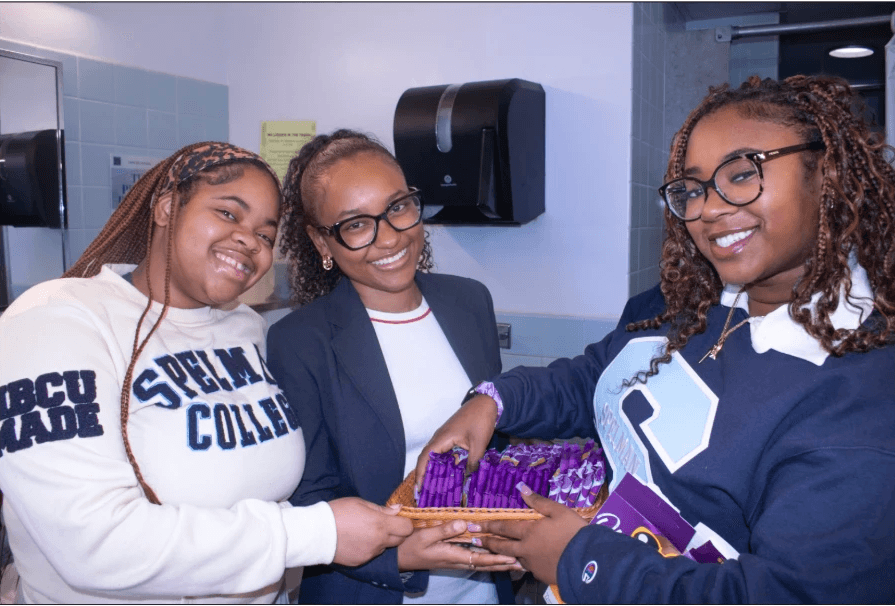
Earlier in February, the 84th Spelman Student Government Association launched a new initiative to provide free menstrual products to first-year students, addressing the long-standing reality of period poverty among Black women and advancing dignity, access and care on campus. Currently, this program is available exclusively to first-year students, but the SGA is exploring opportunities to expand access campus-wide in the future.
At an institution dedicated to the education and empowerment of Black women, no student should have to choose between attending class and managing a basic biological need. Yet, period poverty and the lack of access to menstrual products due to financial barriers have affected generations of African American women. This includes college students navigating rising costs and academic pressures.
In response, the SGA has launched The Period Project, a new initiative to provide free menstrual products to first-year students while promoting menstrual equity, dignity and wellness across campus. The program was one of SGA President Cori’anna White’s key action plans for the 2025-2026 academic year, developed with support from Amari Ann Shepard, SGA Director of Compliance and Safety.
“In the same way we see the institution giving away toilet paper in bathrooms, it should be the same for period products,” White said. “At the end of the day, this is an all-women's institution. A Black one at that, the number one at that.”
While The Period Project addresses an immediate need on campus, the emphasis of menstrual inequity did not emerge overnight. Instead, it is rooted in longstanding systems of inequality that have shaped the economic realities of Black women for generations.
“Period poverty has deep roots in structural racism and economic inequality,” Dr. Sharunda D. Buchanan, a race, gender and medicine professor at Spelman, said. “Centuries of labor discrimination, wage gaps, housing segregation and limited generational wealth mean many Black women live with greater financial insecurity.”
Efforts like SGA’s initiative are not only acts of student support, but a part of a larger struggle for health equity and reproductive justice.
Beyond historical inequities, the financial burden of menstruation is combated with the higher cost of products marketed toward women, a phenomenon commonly known as the “pink tax.” For many students, these recurring expenses add up quickly, especially amid broader economic uncertainty and rising living costs.
The Period Project is intended to ease that burden for those most affected, specifically young college students who are already plagued by academic stress. Going to a school like Spelman, where excellence is both a tradition and an expectation, the pressure to succeed can feel especially high.
Being “number one” is not simply an aspiration, but often a standard students feel compelled to meet in every aspect of their lives. Within this environment, basic struggles such as managing one’s menstrual cycle without reliable access to products can become an additional strain. By addressing these everyday barriers, the initiative recognizes that student success is not only shaped by intellectual ability but also by whether fundamental needs are met.
“We’re living in a world where there’s a lot of political turmoil, and rights that we once had are being restricted,” White said. “We as African Americans, especially women, are at the forefront being affected the most. This project is to address that financial barrier for students who are at Spelman, a very expensive and private institution.”
The initiative seeks not only to provide products, but also to challenge the economic pressures that make basic menstrual care inaccessible for many students.
“Menstrual equity, especially on an all-women’s campus, is a necessity to us as students,” freshman Aria Nobles said. “It’s an important issue to students and this period project by SGA could be the beginning of a new standard for the growth of menstrual equity on Spelman's campus.”
Beyond the financial burden, lack of access to menstrual products directly affects students’ ability to fully participate in campus life and succeed academically. White stressed that basic necessities are foundational to students' well-being and classroom performance.
“There’s no way you can expect someone to focus in class if they don’t have the necessities that they need to be successful throughout the day,” White said. “That is having a period pad, that is having a tampon and having a panty liner. That is having access to these resources.”
Menstrual cycles are a reality numerous students quietly navigate each month, highlighting why initiatives like The Period Project are not simply about convenience but about ensuring that every student has the support needed to learn, engage and thrive.
“Menstrual health is not separate from your brilliance—it is part of your wholeness,” Buchanan said.
Earlier in February, the 84th Spelman Student Government Association launched a new initiative to provide free menstrual products to first-year students, addressing the long-standing reality of period poverty among Black women and advancing dignity, access and care on campus. Currently, this program is available exclusively to first-year students, but the SGA is exploring opportunities to expand access campus-wide in the future.
At an institution dedicated to the education and empowerment of Black women, no student should have to choose between attending class and managing a basic biological need. Yet, period poverty and the lack of access to menstrual products due to financial barriers have affected generations of African American women. This includes college students navigating rising costs and academic pressures.
In response, the SGA has launched The Period Project, a new initiative to provide free menstrual products to first-year students while promoting menstrual equity, dignity and wellness across campus. The program was one of SGA President Cori’anna White’s key action plans for the 2025-2026 academic year, developed with support from Amari Ann Shepard, SGA Director of Compliance and Safety.
“In the same way we see the institution giving away toilet paper in bathrooms, it should be the same for period products,” White said. “At the end of the day, this is an all-women's institution. A Black one at that, the number one at that.”
While The Period Project addresses an immediate need on campus, the emphasis of menstrual inequity did not emerge overnight. Instead, it is rooted in longstanding systems of inequality that have shaped the economic realities of Black women for generations.
“Period poverty has deep roots in structural racism and economic inequality,” Dr. Sharunda D. Buchanan, a race, gender and medicine professor at Spelman, said. “Centuries of labor discrimination, wage gaps, housing segregation and limited generational wealth mean many Black women live with greater financial insecurity.”
Efforts like SGA’s initiative are not only acts of student support, but a part of a larger struggle for health equity and reproductive justice.
Beyond historical inequities, the financial burden of menstruation is combated with the higher cost of products marketed toward women, a phenomenon commonly known as the “pink tax.” For many students, these recurring expenses add up quickly, especially amid broader economic uncertainty and rising living costs.
The Period Project is intended to ease that burden for those most affected, specifically young college students who are already plagued by academic stress. Going to a school like Spelman, where excellence is both a tradition and an expectation, the pressure to succeed can feel especially high.
Being “number one” is not simply an aspiration, but often a standard students feel compelled to meet in every aspect of their lives. Within this environment, basic struggles such as managing one’s menstrual cycle without reliable access to products can become an additional strain. By addressing these everyday barriers, the initiative recognizes that student success is not only shaped by intellectual ability but also by whether fundamental needs are met.
“We’re living in a world where there’s a lot of political turmoil, and rights that we once had are being restricted,” White said. “We as African Americans, especially women, are at the forefront being affected the most. This project is to address that financial barrier for students who are at Spelman, a very expensive and private institution.”
The initiative seeks not only to provide products, but also to challenge the economic pressures that make basic menstrual care inaccessible for many students.
“Menstrual equity, especially on an all-women’s campus, is a necessity to us as students,” freshman Aria Nobles said. “It’s an important issue to students and this period project by SGA could be the beginning of a new standard for the growth of menstrual equity on Spelman's campus.”
Beyond the financial burden, lack of access to menstrual products directly affects students’ ability to fully participate in campus life and succeed academically. White stressed that basic necessities are foundational to students' well-being and classroom performance.
“There’s no way you can expect someone to focus in class if they don’t have the necessities that they need to be successful throughout the day,” White said. “That is having a period pad, that is having a tampon and having a panty liner. That is having access to these resources.”
Menstrual cycles are a reality numerous students quietly navigate each month, highlighting why initiatives like The Period Project are not simply about convenience but about ensuring that every student has the support needed to learn, engage and thrive.
“Menstrual health is not separate from your brilliance—it is part of your wholeness,” Buchanan said.