Morgan Richardson
Morgan Richardson
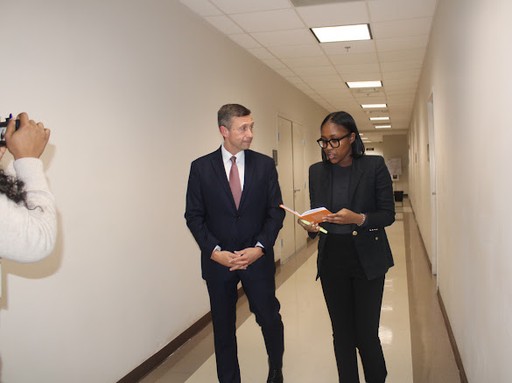
A year into his term at the Democratic National Committee (DNC) and months away from midterm election season, party leader Ken Martin landed in Atlanta for his first visit to the Atlanta University Center (AUC).
In the event hosted by Morehouse’s Student Government Association (SGA), student leaders across the three institutions gathered for an hour-long roundtable discussion focused on shared challenges, and finding collaborative solutions. Armed with questions—written in notebooks, scattered across loose pages and committed to memory—students arrived eager to grasp the Democratic Party’s direction and the meaning of visiting the prestigious institutions at the heart of the pivotal battleground state.
Nonpartisan identification is significant among young adults. Polls from the 2024 election indicated that nearly 56% of Gen Z voters identified as independent, a larger share than in most older age groups. Georgia, is one of the "youngest" states in the country, with young adults aged 18–29 accounting for 23 % of Georgia’s residents. The AUC enrolls over 10,000 students collectively each year — a key demographic for civic engagement on campuses and in the state’s political future.
“This is an important and timely conversation we’re going to have with the chairman of the party,” Senate Pro Tempore Christopher Landry Jr. said.
In early January, the DNC announced its When We Count campaign, marking its largest-ever voter registration effort, a seven-figure investment aimed at reaching young voter communities. This effort is paired with the launch of its When We Count Youth Fellowship, a paid, part-time fellowship that trains students to register new voters, working to close voter registration gaps in priority congressional districts.
“It’s really important for us to actually make sure we’re mobilizing new voters all over the country. We need to engage early and engage often,” Martin told students.
With midterm election season just months away, mobilizing college-aged and first time voters has emerged as a central priority for campaigns across the country. Though the Democratic Party is adequately positioned for the upcoming midterm elections, a great deal of work remains to secure crucial wins across the nation.
“When you win elections you change lives,” Martin said.
Since 2020, the country has observed a noticeable decrease in Black voter interest, specifically in young Black men. Although the trend has increased with the recent wins of New Jersey’s Mikie Sherill, Virginia’s Abigail Spanberger and New York City’s Zohran Mamdani, the stark difference could pose a potential concern for the Democratic Party.
“We lost some ground for sure, but Black men still were standing with the Democratic party — we just have to be better at our jobs,” Martin said.
The possibility of another blue wave in the midterm elections lies in the party’s ability to reach voters. However, a significant deterrent seems to be the way Democrats have tried to garner votes. Students voiced concern about the Democratic Party's vague messaging, appealing to disaffected Republicans and centrists while disengaging its base.
In an effort to modernize communication, counter misinformation and amplify messaging to supporters, the DNC launched its first-ever live broadcast program in 2025.
“People have a good B.S. meter —they can smell through it— they want authenticity, they want people who are actually going to stand up and fight for what they believe in — not just tell people what they want to hear to get their vote,” Martin said.
Martin and his team take the concerns shared in the conversation back to D.C., ensuring they reach party leaders. Attendees were highly encouraged to apply to the When We Count Fellowship, with the inaugural cohort launching this spring.
A year into his term at the Democratic National Committee (DNC) and months away from midterm election season, party leader Ken Martin landed in Atlanta for his first visit to the Atlanta University Center (AUC).
In the event hosted by Morehouse’s Student Government Association (SGA), student leaders across the three institutions gathered for an hour-long roundtable discussion focused on shared challenges, and finding collaborative solutions. Armed with questions—written in notebooks, scattered across loose pages and committed to memory—students arrived eager to grasp the Democratic Party’s direction and the meaning of visiting the prestigious institutions at the heart of the pivotal battleground state.
Nonpartisan identification is significant among young adults. Polls from the 2024 election indicated that nearly 56% of Gen Z voters identified as independent, a larger share than in most older age groups. Georgia, is one of the "youngest" states in the country, with young adults aged 18–29 accounting for 23 % of Georgia’s residents. The AUC enrolls over 10,000 students collectively each year — a key demographic for civic engagement on campuses and in the state’s political future.
“This is an important and timely conversation we’re going to have with the chairman of the party,” Senate Pro Tempore Christopher Landry Jr. said.
In early January, the DNC announced its When We Count campaign, marking its largest-ever voter registration effort, a seven-figure investment aimed at reaching young voter communities. This effort is paired with the launch of its When We Count Youth Fellowship, a paid, part-time fellowship that trains students to register new voters, working to close voter registration gaps in priority congressional districts.
“It’s really important for us to actually make sure we’re mobilizing new voters all over the country. We need to engage early and engage often,” Martin told students.
With midterm election season just months away, mobilizing college-aged and first time voters has emerged as a central priority for campaigns across the country. Though the Democratic Party is adequately positioned for the upcoming midterm elections, a great deal of work remains to secure crucial wins across the nation.
“When you win elections you change lives,” Martin said.
Since 2020, the country has observed a noticeable decrease in Black voter interest, specifically in young Black men. Although the trend has increased with the recent wins of New Jersey’s Mikie Sherill, Virginia’s Abigail Spanberger and New York City’s Zohran Mamdani, the stark difference could pose a potential concern for the Democratic Party.
“We lost some ground for sure, but Black men still were standing with the Democratic party — we just have to be better at our jobs,” Martin said.
The possibility of another blue wave in the midterm elections lies in the party’s ability to reach voters. However, a significant deterrent seems to be the way Democrats have tried to garner votes. Students voiced concern about the Democratic Party's vague messaging, appealing to disaffected Republicans and centrists while disengaging its base.
In an effort to modernize communication, counter misinformation and amplify messaging to supporters, the DNC launched its first-ever live broadcast program in 2025.
“People have a good B.S. meter —they can smell through it— they want authenticity, they want people who are actually going to stand up and fight for what they believe in — not just tell people what they want to hear to get their vote,” Martin said.
Martin and his team take the concerns shared in the conversation back to D.C., ensuring they reach party leaders. Attendees were highly encouraged to apply to the When We Count Fellowship, with the inaugural cohort launching this spring.