Maya Evans
Maya Evans
A Masterclass in Stewardship: Hank Willis Thomas in Dialogue with Dr. Cheryl Finley
A Masterclass in Stewardship: Hank Willis Thomas in Dialogue with Dr. Cheryl Finley
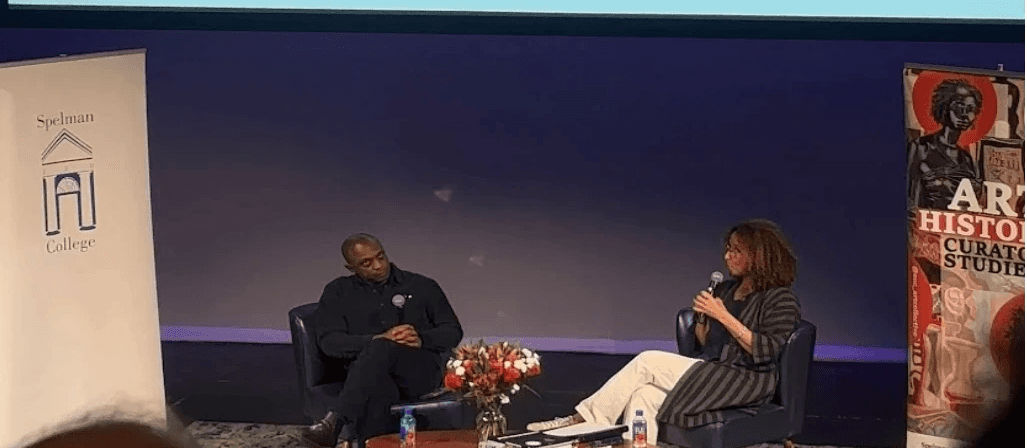
Last week, the Black Box Theatre was transformed into a site of intellectual intimacy as the AUC Art History and Curatorial Studies Collective hosted its latest Distinguished Lecture. The event featured world-renowned conceptual artist Hank Willis Thomas in a profound dialogue with Dr. Cheryl Finley, the Walton Endowed Professor and director of the collective.
This conversation served as a homecoming of sorts for Thomas, who is an admirer of HBCUs, that reflected upon the “collectivity within the space”, a sentiment that resonated deeply with the packed audience of students, faculty and visiting guests.
“It’s not about getting in the door; it is about what you do when you are in it,” Thomas said, challenging the next generation of “culture-ists” to look beyond traditional institutional gatekeeping.
Thomas, whose work often interrogates identity, perspective, commodities, media and popular culture, spoke extensively about the role of archives in his creative process. Having grown up alongside his mother, the celebrated scholar and photographer Dr. Deborah Willis, Thomas views history not as a static record but as a living resource.
“Art has the power to open portals in people’s hearts and minds,” Thomas said. He urged students to tap into the “riches of the Black experience across the diaspora” to create work that functions as a bridge between the past and a liberated future.
The dialogue, masterfully moderated by Dr. Finley, delved into the symbiosis of curation and creation. As an artist who frequently collaborates with curators and historians, Thomas noted that “form is nothing more than an extension of content,” emphasizing that the intellectual sharpness of a project is what ultimately sustains its longevity in the international art market.
For the many Art History majors and Curatorial Studies minors in attendance, the lecture was a masterclass in stewardship. Thomas touched on the importance of legacy planning, echoing the values of global institutions while maintaining a grassroots commitment to community-building.
“We are all human–and there are always these human connections that we can find,” Thomas said, reminding the audience that even at the highest level of the art world, curiosity and empathy remain its most valuable aspects.
The event concluded with a call to action for the AUC community to embrace their roles as the new visionaries of the art landscape. Thomas’s visit served as an affirmation that the resistance work being done within the halls of Spelman, Morehouse, Clark Atlanta and Morris Brown is not only institutionally sound but nationally significant.
“I’m very proud of the work happening here,” Thomas noted, reflecting on the evolution of the AUC Art Collective. “The world needs the portals you are building.”
Information regarding future lectures and programming for the AUC Art History and Curatorial Studies Collective can be found on the AUC Art History and Curatorial Studies Collective website and social media platforms.
Last week, the Black Box Theatre was transformed into a site of intellectual intimacy as the AUC Art History and Curatorial Studies Collective hosted its latest Distinguished Lecture. The event featured world-renowned conceptual artist Hank Willis Thomas in a profound dialogue with Dr. Cheryl Finley, the Walton Endowed Professor and director of the collective.
This conversation served as a homecoming of sorts for Thomas, who is an admirer of HBCUs, that reflected upon the “collectivity within the space”, a sentiment that resonated deeply with the packed audience of students, faculty and visiting guests.
“It’s not about getting in the door; it is about what you do when you are in it,” Thomas said, challenging the next generation of “culture-ists” to look beyond traditional institutional gatekeeping.
Thomas, whose work often interrogates identity, perspective, commodities, media and popular culture, spoke extensively about the role of archives in his creative process. Having grown up alongside his mother, the celebrated scholar and photographer Dr. Deborah Willis, Thomas views history not as a static record but as a living resource.
“Art has the power to open portals in people’s hearts and minds,” Thomas said. He urged students to tap into the “riches of the Black experience across the diaspora” to create work that functions as a bridge between the past and a liberated future.
The dialogue, masterfully moderated by Dr. Finley, delved into the symbiosis of curation and creation. As an artist who frequently collaborates with curators and historians, Thomas noted that “form is nothing more than an extension of content,” emphasizing that the intellectual sharpness of a project is what ultimately sustains its longevity in the international art market.
For the many Art History majors and Curatorial Studies minors in attendance, the lecture was a masterclass in stewardship. Thomas touched on the importance of legacy planning, echoing the values of global institutions while maintaining a grassroots commitment to community-building.
“We are all human–and there are always these human connections that we can find,” Thomas said, reminding the audience that even at the highest level of the art world, curiosity and empathy remain its most valuable aspects.
The event concluded with a call to action for the AUC community to embrace their roles as the new visionaries of the art landscape. Thomas’s visit served as an affirmation that the resistance work being done within the halls of Spelman, Morehouse, Clark Atlanta and Morris Brown is not only institutionally sound but nationally significant.
“I’m very proud of the work happening here,” Thomas noted, reflecting on the evolution of the AUC Art Collective. “The world needs the portals you are building.”
Information regarding future lectures and programming for the AUC Art History and Curatorial Studies Collective can be found on the AUC Art History and Curatorial Studies Collective website and social media platforms.